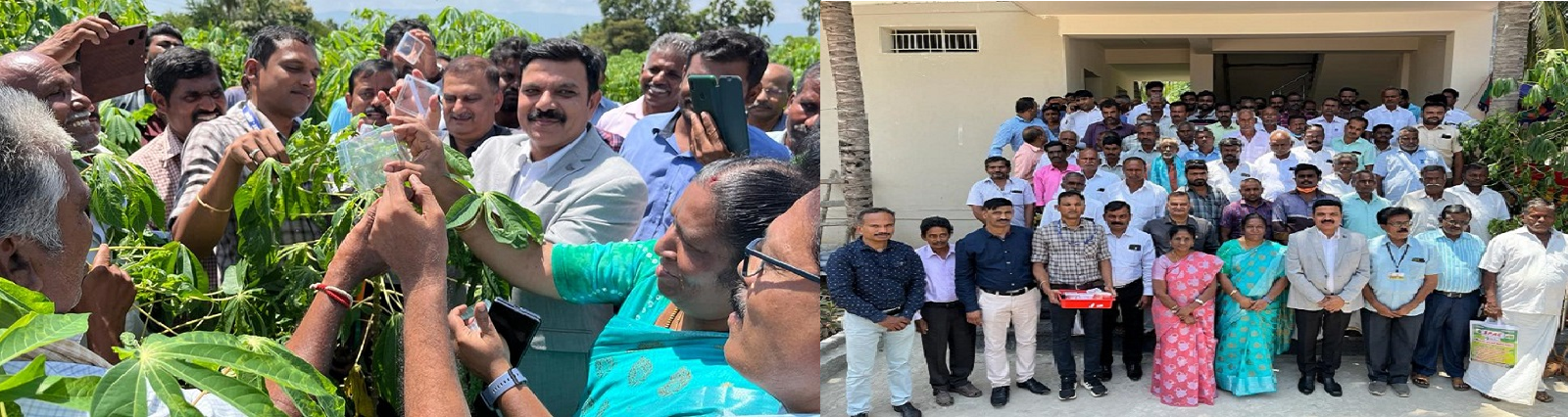


The ICAR-National Bureau of Agricultural Insect Resources (ICAR-NBAIR) is a premier institution that seamlessly integrates basic and applied sciences in agricultural entomology. The Bureau’s Museum has been designated by the Ministry of Environment & Forests as the “National Repository” under the Biological Diversity Act, 2002 for agriculturally important insects, mites & spiders. The National Insect Museum now holds around 0.41 million insect specimens (dry and wet) including around 500 types. In 2024, extensive exploratory surveys led to the discovery and description of 48 insect species across various orders, including Coleoptera, Diptera, Hemiptera, Hymenoptera, and Thysanoptera, along with a new species of Spider and Nematodes. Advanced taxonomic studies, including revisionary works, taxonomic rectifications, and redescriptions, were conducted. To support farmers, extension agencies, and researchers, a database on Indian Dryophthorinae species was developed. Additionally, the taxonomic expertise at ICAR-NBAIR extended identification services to State Agricultural Universities, private companies, and ICAR institutes. Diagnostic keys were published for multiple insect taxa, including Orionis, Leluthia, Yelicones, Dacus, Gynaikothrips, Scirtothrips, Paraputo, and Carrhotus. Furthermore, new host and pest records were documented for key agricultural and horticultural crops.
The molecular biology laboratories, recently upgraded at ICAR-NBAIR, have made significant progress in DNA barcoding and gene editing of agriculturally important insect pests. Molecular characterization techniques, utilizing COI gene, elongation factor, 28S rRNA gene, LAMP, RPA, and species-specific markers, were employed to study key invasive pests such as Hypogeococcus pungens, Fistulococcus pokfulamensis, and Leucoptera malifoliella. A major milestone was the genome sequencing and chromosome-scale de novo genome assembly of Polyphagotarsonemus latus. NBAIR BtG4 10% WSL strain of Bacillus thuringiensis serovar kurstaki was the first biopesticide from the institute to be successfully registered under CIB & RC under section 9(3) for the management of Helicoverpa armigera on pigeon pea. Additionally, research on black soldier fly (BSF) focused on its potential in organic waste degradation, with studies characterizing its gut microflora to enhance understanding of the degradation process.
ICAR-NBAIR has established a state of art Live Insect Repository Unit (LIRU) for maintenance of nucleus culture of live insects and the facility continues to develop mass multiplication techniques of natural enemies in pest management. The LIRU maintains 137 live insect species/ strains of parasitoids, predators, pest insects and detritivorous insect. These insects are being mass multiplied and supplied to different stakeholders throughout the year. The Bureau is also known for rich repository of entomopathogenic organisms and maintaining more than 1000 species/ strains of bacteria, viruses, fungus, nematodes etc. The Bureau identified native natural enemies of invasive pests, including Blaptostethus pallescens, which was demonstrated to effectively reduce Thrips parvispinus populations in chilli crop. Novel oil-based biopesticide formulations were developed for managing pests like chilli thrips, Fall Armyworm and rugose whiteflies. Additionally, chemoecology based platforms were employed to identify attractant and repellent compounds, which were then incorporated into nanomatrix-based delivery systems. Safety assessments were also conducted to evaluate the impact of nanoparticles on non-target beneficial insects such as Trichogramma japonicum, T. chilonis, and Chrysoperla zastrowi sillemi, ensuring their compatibility with biological control programs.
The institute also advanced research on plant-derived bioactive compounds for stored product pest management. A modified wooden rectangular hive with a median partition was developed, enabling the harvest of pollen-free stingless bee honey without damaging the brood. Additionally, ICAR-NBAIR successfully supplied 544.05 lakh insects, comprising 239.24 lakh host insects and 304.81 lakh natural enemies, to various organizations. Over 145 research papers in high rated journals were published and 2 patents & 4 copyrights were granted during 2024.
Through taxonomic expertise, molecular advancements, and eco-friendly pest management solutions, ICAR-NBAIR continues to address critical challenges in sustainable agriculture, contributing significantly to insect biodiversity conservation and pest management strategies.
My gratitude to Dr. M L Jat, Secretary (DARE) & Director General (ICAR), Dr. D K Yadava, DDG (Crop Science), ICAR and Dr. Poonam Jasrotia, ADG (Plant Protection & Biosafety) for their unwavering support and guidance. I would also like to acknowledge the funding agencies such as ICAR, FAO, DST, DBT, CSB, CDB and other private companies for supporting 37 externally funded projects.
Looking forward to many more productive years ahead.
Bengaluru Dr. T. Venkatesan
May 2026 Director (Acting)